Global investigation highlights growing threat from illegal wildlife trade
Operation Thunder 2025 seizes 30,000 live animals across 134 countries
Interpol and the World Customs Organisation (WCO) seized a record number of protected plants, animals and timber in the annual Operation Thunder which took place during September and October this year.
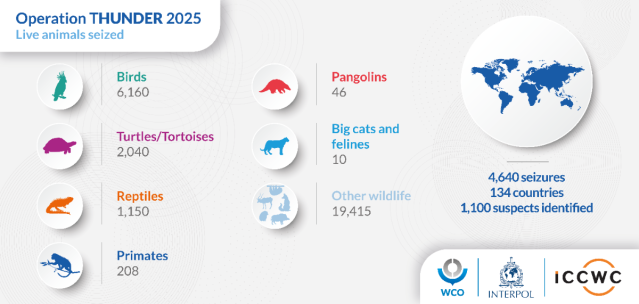
Law enforcement agencies comprising customs, police, border security, forestry and wildlife authorities from 134 countries made a total of 4,640 seizures during the operation.
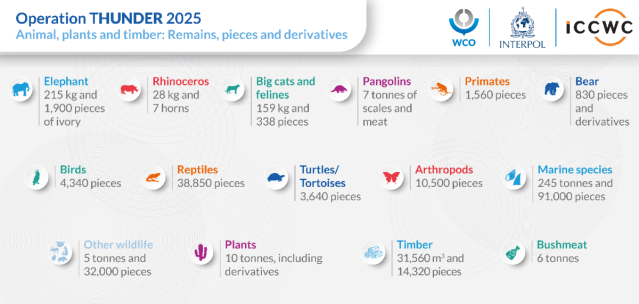
This included a record high seizure of 30,000 live animals – driven largely by the demand for exotic pets. But the majority of wildlife trafficking involves animal remains, parts and derivatives, often used in traditional medicine or specialty foods.
Coordinated by WCO and INTERPOL, the operation sought to intercept and seize illegally traded wildlife and forestry commodities across the global supply chain and identify, disrupt, investigate and dismantle criminal networks involved in these types of environmental crime.
Maliki Wardjomto, TRAFFIC Africa Coordinator for TWIX (alliance for law enforcement information exchange):
This year's Operation Thunder is once again a triumph of international collaboration and global law-enforcement action against wildlife crime and corruption. We congratulate Interpol and WCO, and everyone involved.
However, the growing number of seizures should act as an alarm call to the world about the devastation being wreaked on species and ecosystems by organised criminal gangs who are making huge profit from wildlife crime."
Operation Thunder 2025 revealed an escalating illicit trade of bushmeat, the term used for wild animal meat, especially from tropical regions.
Belgian authorities intercepted primate meat, Kenyan officials seized over 400 kilograms of giraffe meat and Tanzanian law enforcement recovered zebra and antelope meat and skins valued at approximately USD 10,000. Globally, a record 5.8 tonnes of bushmeat was seized, with a notable increase in cases from Africa into Europe.
In 2025, enforcement actions also uncovered an increase in the trafficking of marine species, with more than 245 tonnes of protected marine wildlife seized worldwide, including 4,000 pieces of shark fins.
While iconic large mammals often dominate headlines in the fight against environmental crime, growing threats also include the trade of smaller species and plants.
For example, Operation Thunder 2025 revealed a sharp rise in the trafficking of exotic arthropods. Nearly 10,500 butterflies, spiders and insects—many protected under CITES—were seized around the world. Though tiny in size, these creatures play vital ecological roles. Their removal destabilizes food chains and introduces invasive species or diseases, posing serious biosecurity and public health risks.