Protecting forests, nature and livelihoods: Data, Tech, and Legacy
As five-year forestry project concludes, TRAFFIC reflects on cross-continental success advancing legal timber trade
From stronger national laws and enforcement staff trained to spot illegality, to sophisticated technology which spots likely corruption or uses AI to identify species of wood, the enormous timber supply chain from the Congo Basin to China is undergoing transformation.
This is largely thanks to a recently concluded five year project funded by NORAD/NICFI aimed at leveraging legality along China’s timber supply to reduce deforestation.
A closing workshop held in Ebolowa, Cameroon (December 10-12) brought together over 60 stakeholders to celebrate achievements and chart a course for ongoing action protecting the Congo Basin, the world’s second-largest rainforest.
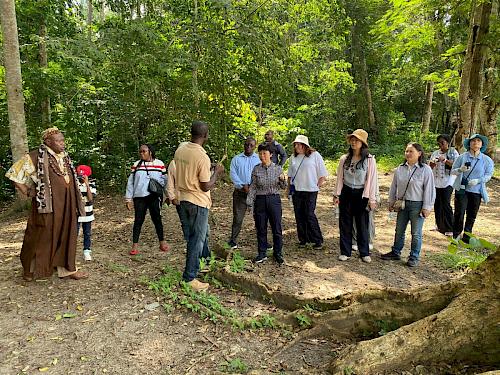
The event concluded with an exchange visit by the Chinese delegation, accompanied by TRAFFIC and partners, at the National Forestry School (ENEF) in Mbalmayo on 13 December 2025. The exchange visit enabled participants to see an experimental forest and various tree species, and to visit the timber workshops of ENEF, where development of the wood identification tool for Congo Basin species is underway.
When we see the transformation in the field, and within the communities, which has been delivered through this five year project... it gives us the energy to continue... because we need to see this transformation everywhere in the Congo Basin."
Mr. Patrice KAMKUIMO – TCAF's Senior Programme OfficerThe workshop was a pivotal moment, synthesising the immense achievements of the project and celebrating successes rooted in a cross-border approach that strengthened the way timber is tracked and verified all the way from African forests to Asian markets.
Technology and Transparency: The New Tools
The initiative focused on deploying innovative, smart technology and big data analysis to enhance due diligence and tackle corruption:
- TimberStats: This interactive data platform combats financial crime by comparing national timber import and export data, identifying significant inconsistencies that signal potential trafficking, fraud, and money laundering risks. It is a powerful tool for law enforcement and financial institutions to pinpoint suspicious trade activity.
- Wood Identification: This technology uses a smartphone and macro-lens attachment to quickly and reliably verify wood species in the field, making it harder for illegal timber to pass undetected.
- Financial Crime Detection: TRAFFIC pioneered technical guidance on using Big Data techniques to analyse forestry title registries and identify corruption risks, allowing financial crime agencies to track high-risk individuals and companies.
Strengthening Governance and Industry Accountability
The project has delivered concrete changes in policy and practice across continents:
- Capacity Building: The initiative created a comprehensive network of expertise. In Asia alone, partners trained more than 300 forest rangers and customs officers across 47 Vietnamese provinces, as well as over 120 customs officers in China, equipping frontline staff with the skills to identify legal timber from illegal timber.
- Industry Compliance: TRAFFIC successfully engaged the private sector to develop and implement Codes of Conduct. Over 200 timber companies in China passed Code of Conduct verification, demonstrating a shared commitment to legal sourcing.
- Source Country Systems: Support was provided to strengthen government-owned traceability and financial systems, including the complex SIGIF 2 in Cameroon and the SIVL in the Republic of Congo, which aim to manage all timber transactions to ensure legal exploitation. TRAFFIC also supports the development and implementation of robust National Legality Frameworks in timber-producing countries. These frameworks define legal timber and provide the basis for effective enforcement.
During the Speech of The Ministry of Forestry and Wildlife of Cameroon (MINFOF) to officially launch the Regional Closing Workshop of the NORAD project, Dr NDIFOR Charles, Director of Community Forests, on behalf of the Director of Forests, Representative of the Minister of Forestry and Wildlife of Cameroon emphasised
For five years, the NORAD initiative, “Strengthening Legality in China’s Timber Supply to Reduce Deforestation,” has represented something far greater than its title. It has been a testament to a fundamental, interconnected truth: that the stewardship of our majestic forests in Cameroon and Congo is inextricably linked to responsible demand continents away. It has been a bold experiment in transcontinental accountability."
Community Forestry and Social Justice
A key focus of the initiative was on empowering Indigenous Peoples and Local Communities (IPLCs):
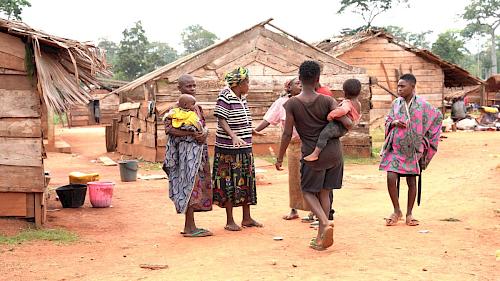
- Reclaiming Ownership: The project provided support to communities, including the Baka Pygmy tribe, to overcome complex legal hurdles and develop their own simple forest management plans.
- Transforming Lives: By engaging in legal, sustainable community forestry, local groups can generate revenues to fund long-term development projects, such as building schools, health centres, and wells, transforming entire communities.
- Scaling Success: The indigenous community representatives at the workshop stressed that this work is essential because managing a forest requires local knowledge, the right tools, and an awareness of the challenges.
TRAFFIC has been a blessing. Thanks to TRAFFIC, we can breathe again. ... We were stuck... But with the contract signed with TRAFFIC... We now have... help to evaluate and renew our management plan."
Majesty Ebongue Onésime, the Chief of Beul Village and Community Forest Manager.
The forest is our source of life. When I see the forest and resources disappearing, it is our life that is consequently at risk of disappearing. TRAFFIC brings back hope in helping us to secure and well-manage our community forest. We are more than grateful.
Moizol Sosso Gladys, Young Woman and Indigenous Peoples Leader. From the Village Mayos, the single village of Indigenous Peoples within the community forest CADBAP.
The Path to Sustainability and Growth
The final sessions in Ebolowa focused on ensuring the long-term viability of the project's achievements, discussing how to overcome challenges in system deployment and promoting institutional ownership.
The project has improved the capacities of private sector Representatives in the Republic of Congo in various critical and emerging issues important to drive systemic positive change within the timber supply chain. From the timber trade legality to financial crime, ethics, integrity, and transparency in the timber supply chain, the private sector has been equipped to address the issues. However, there is still a need to extend this type of support to many other private sector stakeholders. ‘’
Achille Tsieta, UNICONGO, CIB-OLAM
The collective work accomplished sets a strong precedent for using technology and transparency to create a global timber trade that is legal, sustainable, and beneficial for both the planet and the communities that depend on it.
Norway's International Climate and Forest Initiative

NICFI is administered by the Norwegian Ministry of Climate and the Environment in collaboration with Norad – The Norwegian Agency for Development Cooperation. The initiative supports bilateral agreements with forest countries, multinational organisations and civil society.